

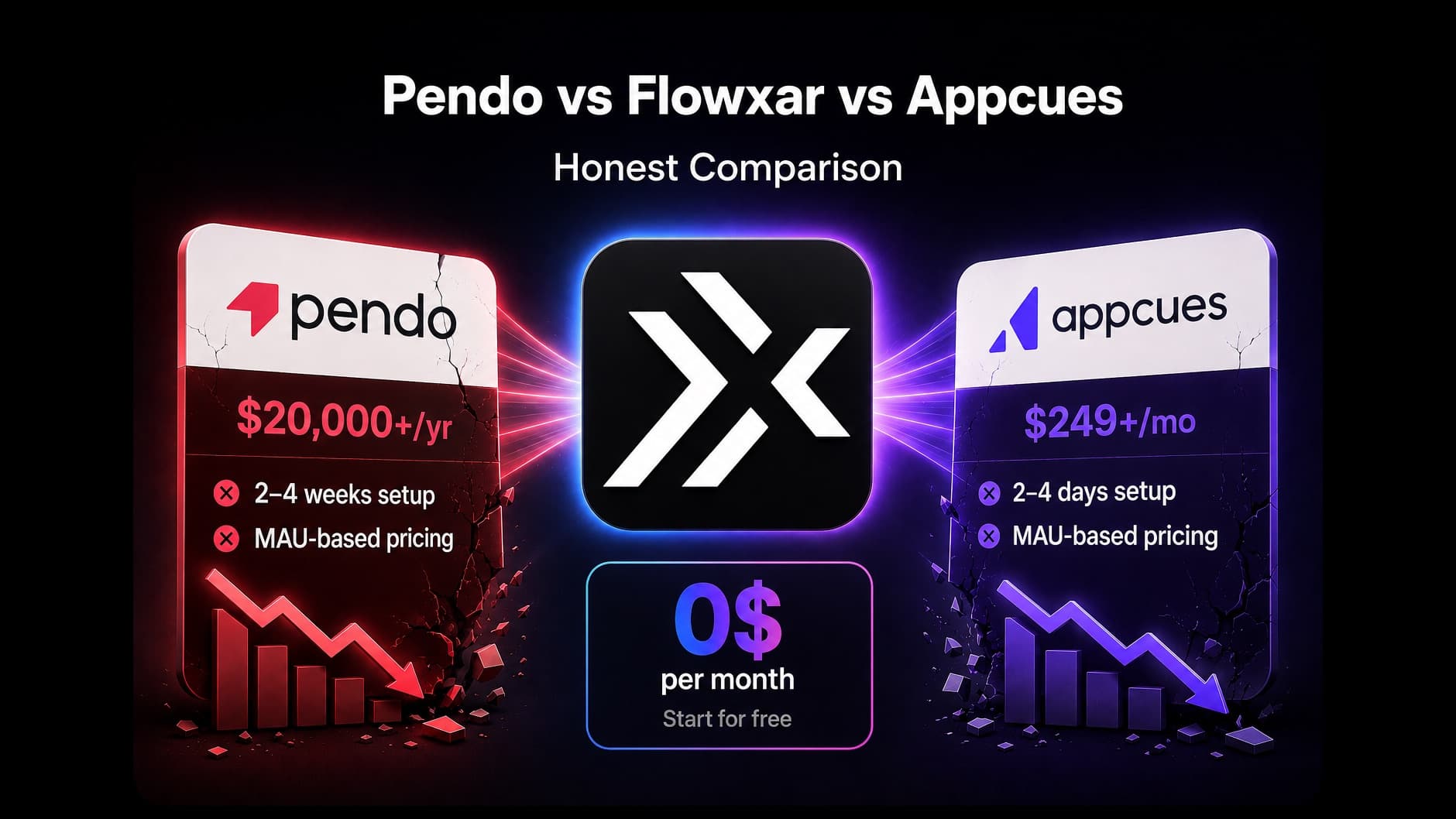
If you're evaluating onboarding tools for your SaaS product, you've hit the same shortlist everyone else lands on: Pendo, Appcues, and increasingly, Flowxar. This article breaks them down without the sales deck spin — pricing, setup, features, and the edge cases each vendor would rather you not ask about.
TL;DR — The Short Answer
| Pendo | Appcues | Flowxar | |
|---|---|---|---|
| Starting price | $20,000+/yr | $249+/mo | €29/mo |
| Pricing model | MAU-based | MAU-based | Flat rate |
| Setup time | 2–4 weeks | 2–4 days | 15 minutes |
| No-code builder | ✓ | ✓ | ✓ |
| AI copy generation | ✗ | ✗ | ✓ |
| Shadow DOM isolation | ✗ | ✗ | ✓ |
| Free plan | Limited | 14-day trial | ✓ |
| Best for | Large enterprise | Growing SMB | SMB & mid-market |
Bottom line: If you have a $20k/year software budget and a dedicated Customer Success team to manage it, Pendo is worth the investment. If you're a small or mid-size SaaS team that wants professional onboarding without MAU penalties, Flowxar is the answer.
The Three Tools at a Glance
Pendo
Pendo is the market leader in product analytics and in-app guidance. It's used by companies like Salesforce, Zendesk, and Citrix — and it's priced accordingly. Pendo's core strength is its analytics layer: NPS surveys, session recordings, feature adoption heatmaps. The onboarding flows (what they call "guides") are solid, but the platform is genuinely complex to configure. Expect a 2–4 week implementation engagement with a Pendo Customer Success Manager before your first production flow is live.
The MAU-based pricing is the critical gotcha. A SaaS product with 5,000 MAUs will pay significantly more than one with 500 MAUs — and Pendo's contract terms make it expensive to downgrade.
Appcues
Appcues sits in the middle ground. It's more focused than Pendo (onboarding flows, not analytics-first), and meaningfully faster to get started. Their no-code builder is genuinely good — PMs can build and publish flows without engineering involvement after initial setup. The platform has strong customization options and a clean UI.
The friction points: pricing scales with MAUs (the free trial doesn't warn you how aggressively), the builder can be slow on large SPAs, and analytics depth is shallow compared to Pendo.
Flowxar
Flowxar is the new entrant: a no-code onboarding builder built specifically for teams who want Appcues-quality flows without the MAU tax. The differentiators are flat-rate pricing, built-in AI copywriting (Magic Write), and Shadow DOM isolation that prevents SDK conflicts with the host application.
The trade-off: Flowxar doesn't have Pendo's analytics depth, and it's a newer platform without the same track record of enterprise deployments.
Pricing Comparison
This is where the comparison becomes stark.
Pendo: Entry-level starts around $20,000/year. Mid-tier plans run $40,000–$70,000/year. Enterprise contracts are custom and often exceed $100,000/year. All tiers are MAU-priced — at 10,000 MAUs, you're in a meaningfully different price bracket than at 1,000.
Appcues: Published pricing starts at $249/month (Essentials tier), but this covers a limited MAU count. The Growth tier — which unlocks most of the features you actually want — starts at ~$879/month. Overage fees apply when you exceed your MAU tier.
Flowxar: €29/month (Pro), €99/month (Business), €199/month (Enterprise). No MAU limits on any plan. The flat rate means your tool cost doesn't compound as your product grows.
The practical implication: a SaaS product that grows from 500 to 5,000 MAUs over 18 months will see no price change on Flowxar. On Pendo or Appcues, that growth triggers a plan upgrade conversation.
Setup Time
Pendo setup involves a sales call, contract negotiation, implementation kickoff, snippet installation (which requires careful configuration for SPAs), and a training period. Companies that have been through it report 2–4 weeks from contract signing to first live guide. The complexity is partly by design — it justifies the managed implementation service.
Appcues setup is faster. The snippet is self-serve, documentation is clear, and you can get a basic flow live in a day or two. The multi-day timeline is usually consumed by learning the builder, understanding trigger logic, and getting your first themed flow styled to match your product's design system.
Flowxar setup is one snippet:
<script>
window.OB_CONFIG = { projectId: 'your-project-id' };
</script>
<script src="https://flowxar.com/example.js" async></script>
Paste it before </body>. All flows you publish in the dashboard are immediately delivered to your users — no redeployments. Most teams have their first flow live within 15–30 minutes of signing up.
Key Features
No-Code Builder
All three tools have a no-code visual builder. The key differences:
- Pendo has the most powerful builder but the steepest learning curve. Expect a few hours of training to use it effectively.
- Appcues has the cleanest builder UX and is the most accessible for non-technical PMs. The customization depth is real but the interface hides complexity well.
- Flowxar focuses on speed: create a step, configure the trigger, publish. The builder is opinionated — fewer knobs, faster path from idea to live flow.
AI Copywriting
Only Flowxar includes built-in AI copy generation. Magic Write lets you describe a feature in one sentence and generates step copy for you. It's available on all step types and meaningful on Business plans (500 writes/month). Pendo and Appcues have no equivalent — copy is fully manual.
Analytics
- Pendo wins on analytics depth. Heatmaps, session recordings, NPS, funnel analysis, feature adoption tracking — it's a product analytics platform that also does onboarding.
- Appcues offers flow-level analytics (completion rate, step drop-off) but no session recordings or broader product analytics.
- Flowxar provides per-flow funnel analytics, completion rates, health scores, and session replays of individual users going through a flow. Covers the 80% use case for onboarding analytics.
Selector Stability (DOM Changes)
This is a real-world problem that almost no vendor talks about. When developers update CSS classes or restructure HTML, tooltip anchors break — your flows point at elements that no longer exist.
- Pendo and Appcues use primary selector with a basic fallback. When the primary breaks, you get a broken flow and an alert in the dashboard.
- Flowxar runs a 4-tier Auto-Repair Engine: primary selector → attribute-based fallback (data-testid, aria-label) → text-content anchor → DOM proximity matching. When a Tier 3 or 4 match succeeds, Flowxar patches the stored selector automatically. You don't get paged at 2am because a developer renamed a class.
Shadow DOM Isolation
Flowxar's SDK runs inside a Shadow DOM boundary. This means the SDK's CSS never leaks into your application, and your application's CSS never corrupts the flow UI. Pendo and Appcues inject directly into the host DOM — which means CSS conflicts are real and common, especially on large applications with complex global stylesheets.
Who Each Tool Is For
Choose Pendo if:
- You have a dedicated product analytics budget ($20k+/year)
- You need session recordings, NPS, and feature adoption data in one platform
- You have internal resources (CSM or dedicated PM) to manage implementation and ongoing maintenance
- You're selling to enterprise customers who ask about your vendor stack in security reviews
Choose Appcues if:
- You have 500–5,000 MAUs and a stable, growing user base
- You need a polished no-code builder with strong theming support
- You've outgrown basic onboarding but aren't ready for Pendo-level complexity
- Your PM team is non-technical and needs a clean builder interface
Choose Flowxar if:
- You're an indie founder or a team of 1–20 people
- You want professional onboarding without a 4-week implementation or $20k commitment
- Your user base is growing and you don't want your tool cost to grow with it
- You need AI-generated copy to ship flows faster
- You care about SDK isolation (your application CSS won't be corrupted by the onboarding overlay)
The Verdict
If you're reading this and you're not an enterprise company with a dedicated product analytics team, the choice is straightforward: Pendo is not for you. The pricing model and implementation overhead are designed for companies with existing infrastructure to support it.
Between Appcues and Flowxar, the decision comes down to one question: do you accept MAU-based pricing?
If your product is growing — which is the goal — MAU-based pricing means your tool cost grows in proportion to your success. That's a structural misalignment between your vendor's incentives and yours. Flowxar's flat rate removes that dynamic entirely.
The functional gap between Appcues and Flowxar is real but narrow for most use cases. Appcues has a more mature builder and a larger customer base. Flowxar has flat-rate pricing, built-in AI, and Shadow DOM isolation. For teams at the early-to-mid growth stage, Flowxar covers the 95% use case at a fraction of the cost.
No credit card required